

After seven months of collaboration with Madagascar Coffee Company, we have officially launched our coffee plantation at La Mananara. We are deeply appreciative of co-founder Ryan Kelley for helping guide us through the many steps required to get started. From identifying the right site and sourcing seedlings to securing fertilizer, planning for shade, and integrating native trees, the process has been both complex and rewarding.
Laying the Groundwork: Establishing Our Pilot Coffee Plot
What better way to celebrate the start of spring than with a flavorful cup of coffee? Well, okay, it will be a while until you can sip coffee that comes from the trees we’re planting. But the news is nonetheless exciting: Wildlife Madagascar has officially begun the process of establishing our pilot coffee plot at La Mananara, in partnership with Madagascar Coffee Company and their dedicated team member Mirana Rabarivololona. The start of a new adventure!

Coffee planting is far more complex than simply putting seedlings in the ground. Establishing this pilot plot begins with soil analysis and careful review of soil structure, since rocky soils will not support healthy root development. The team assessed shade conditions, identified appropriate native trees to grow alongside the coffee, and evaluated whether we have nearby, sufficient suitable land to successfully plant 1,000 seedlings this season. Parcels have to be marked and aligned along the contour of the land, planting holes prepared, compost produced, and fertilizer secured before seedlings go into the ground.
This pilot represents more than agriculture. It is the foundation of a long-term livelihood initiative designed to diversify income, strengthen community resilience, and link conservation with economic opportunity.
1,000 Seedlings Planted by Local Community Members

This effort was led on site by our Reforestation Specialist, Domohina Randrianarisoa, who worked with 10 community members to plant 1,000 seedlings. After the first two weeks, all are doing well, an encouraging sign for what lies ahead. These plants will need ongoing care over the next year, and Domohina will be fully engaged in ensuring their success.
What Comes Next: 10,000 Seeds and a Three-Year Journey to Harvest
Between September and October, we will plant 10,000 seeds, which will be nurtured into seedlings and then planted in the field next March. With coffee taking about three years to produce berries, this represents a meaningful investment in both conservation and community livelihoods. The anticipation is already building!
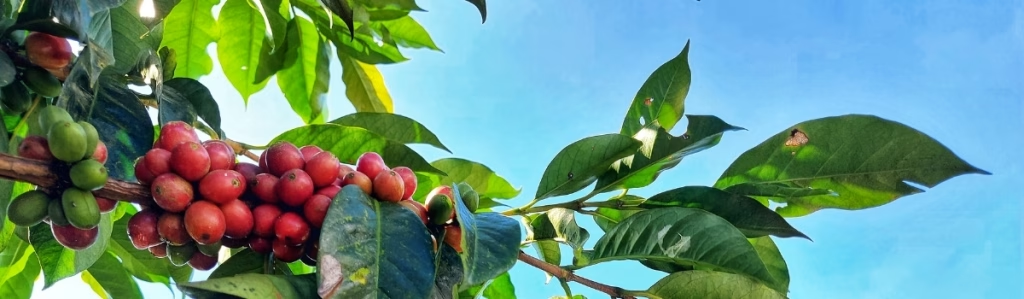
About Our Coffee: Arabica, Agroforestry, and Conservation
Our plantation focuses on Arabica (Coffea arabica) — one of two coffee varieties grown in Madagascar, alongside Robusta (Coffea canephora) — prized for its smooth, complex flavour and grown in Madagascar’s volcanic soils and unique microclimates. In keeping with our conservation mission, the plantation follows a forest-friendly agroforestry model: coffee thrives under shade, which means native canopy trees are planted alongside the crop, supporting biodiversity, restoring soil, and providing the local community with multiple sources of income. This approach is central to our partnership with Madagascar Coffee Company, whose mission is to rebuild Madagascar’s coffee sector in a way that is transparent, sustainable, and rooted in community dignity — ensuring that conservation and livelihoods grow together. To learn more about our coffee initiative and how your daily cup can support conservation in Madagascar, visit our Coffee Initiative page.